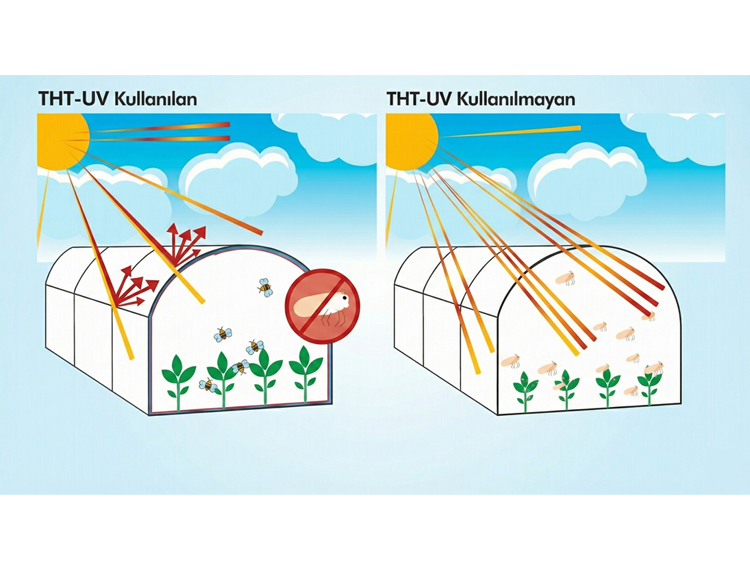
- The Anti-Virus (A.V.) feature prevents whiteflies from spreading viral diseases. In addition, it does not negatively affect the activity of bees.
- At the same time, the THT-UV, which is a product of advanced technology, has a chemical resistance that cannot be compared to classic Hals UVs.
- The service life of greenhouse coverings varies depending on the thickness of the covering and the quality and usage rate of the UV protection used.
1c-) NIQ UV
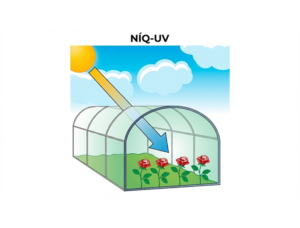
- Greenhouse covers produced with conventional UV are not resistant to sulfur, sulfur-containing agricultural chemicals, or sulfur-based acids. Therefore, when exposed to sulfur and sulfur-based chemicals, they become unusable before the end of their service life. Green greenhouse covers produced with NIQ UV, also known as Anti-Chemical, are extremely resistant to sulfur use.
- Greenhouse covers produced with NIQ UV should be used in plant production where sulfur use is common, such as rose and cucumber cultivation.
- It should be noted that green imitation greenhouse covers colored with paint do not have the same properties.
2-) IR (Infrared Beam Barrier)
2a-) Thermal Properties
- It reduces heat loss from inside the greenhouse through radiation.
- Due to its characteristics, the ambient and soil temperature inside the greenhouse is 2 to 4°C higher than that of non-IR-equipped covers under equivalent conditions on days when the sky is clear.
- It reduces the temperature difference between night and day by allowing the greenhouse to cool more slowly at night.
- It reduces the risk of frost and increases yield and quality.
- In addition, it provides significant savings in greenhouse heating costs.
2b-) Diffusion Property
- The IR additive with the added DIFFUSION feature allows infrared rays from the sun to enter the greenhouse more effectively and in a diffused manner.
- The light from the sun is refracted as it enters the greenhouse, preventing plants from shading each other. This ensures that light reaches even the lower leaves.
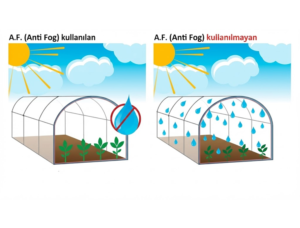
- The A.F. additive used prevents the formation of water droplets on the inner surface of the greenhouse cover by increasing the surface tension of water molecules.
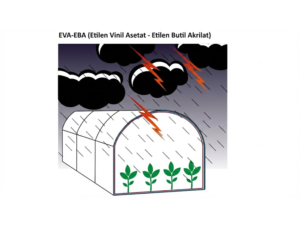
3-) EVA (Ethylene Vinyl Acetate) / EBA (Ethylene Butyl Acrylate)
- Due to the addition of EVA/EBA, the mechanical properties of the greenhouse cover, such as elasticity, tear resistance, and impact resistance, have been enhanced.
- The use of this additive ensures that the greenhouse cover adapts perfectly to different weather conditions (such as strong winds and hail).
- EVA/EBA content also increases the thermal properties and light transmittance of the greenhouse cover.
4-) ANTI FOG
- Thus, it prevents sunburn caused by the lens effect of water droplets forming on the inner surface of the greenhouse cover, as well as fungal diseases caused by water droplets falling onto the plant.
- Cost savings on medication, increased efficiency, and improved quality are achieved.
- The useful life of A.F. contributions is approximately 12-18 months, depending on climatic conditions and greenhouse cover usage.
5-) ANTI MIST
- A.F. reduces fogging that occurs during sunrise in greenhouse covers.
- The useful life of A.Mist depends on the greenhouse cover’s usage conditions, the greenhouse’s structure, and ventilation, and is approximately 3-8 months.
6-) ANTI DUST
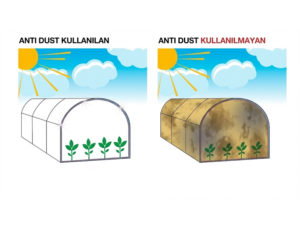
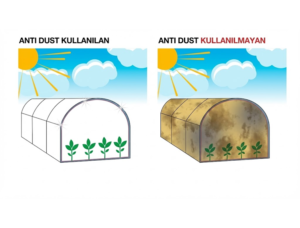
- Prevents dust from sticking to the greenhouse cover.
- It eliminates the risk of sunlight diminishing due to dust.
- It eliminates productivity loss due to insufficient lighting.
- It ensures that the greenhouse always receives better and more efficient light.