


How to Grow Strawberries?
The answer to the question “How to grow strawberries?” depends on choosing the right seedlings, planting at the right time, regular watering, mulching, and managing the growing area according to local climate conditions. For successful strawberry cultivation, all stages—from soil preparation to seedling planting, and from the use of strawberry plastic to the irrigation system—must complement one another.
Since the strawberry’s root system develops close to the surface, care must be taken to avoid both excessive water and prolonged drought. The methods used in open-field and greenhouse production are not entirely the same; particularly in greenhouse production, the cover, ventilation, irrigation, and humidity management must be considered together.
Contents
Toggle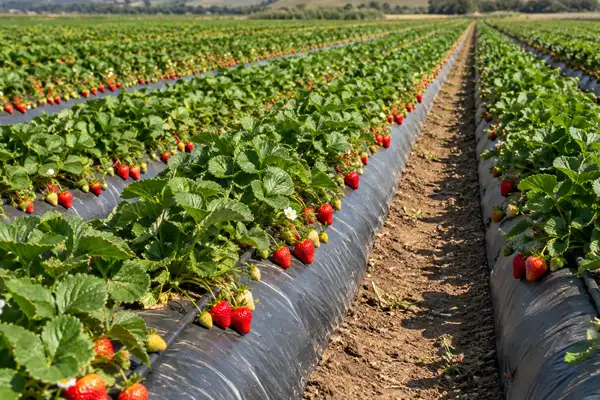
When Should You Plant Strawberries?
It is not correct to answer the question “When should strawberries be planted?” with a single month. Planting time varies depending on the region’s climate, the type of seedling used, the variety, and the target harvest period. In Turkey, different planting periods can be applied for strawberries, including spring, summer, fall, and winter planting.
The same strawberry planting time cannot be used in regions where winters are milder, such as the Mediterranean coastal belt, and in regions where frosts are frequent during the winter. Even in warm-climate regions like Antalya, soil and air temperature, the type of seedling, and the planned production period should be taken into account rather than relying solely on the calendar.
Therefore, when researching which month to plant strawberries, regional conditions must be taken into account. Planting at an inappropriate time can negatively affect the seedling’s root establishment and subsequent growth stages.
How to Choose a Suitable Site for Strawberry Farming?
Strawberry cultivation can be carried out more effectively in sunny areas where water does not pool around the roots for extended periods and where an irrigation system can be installed. Since strawberries are susceptible to certain soil-borne diseases, the crops previously grown on the land and the overall health of the soil should also be evaluated.
When selecting a production site, the following conditions should be considered together:
- Sunlight duration on the land
- Soil drainage characteristics
- Irrigation water quality and capacity
- Previous crop rotation
- Elevation and slope of the land
- Wind conditions
- Ventilation options if a greenhouse is to be used
- Work areas for harvesting and transportation
Especially in intensive commercial production, strawberry cultivation cannot be planned based solely on the number of seedlings. Irrigation lines, mulch width, and maintenance aisles must be determined before planting begins.
How Do You Plant Strawberries?
How to plant strawberries is a process in which the most critical step is preparing the growing bed and irrigation infrastructure before placing the seedlings into the soil. Random planting can disrupt row spacing, cause irrigation water to reach the wrong areas, and make mulching more difficult later on.
1. Prepare the Soil and Planting Beds
Before planting strawberries, the soil should be properly cultivated, and large stones or plant residues that may interfere with planting should be removed. Especially in mulched production, properly prepared soil helps the plastic film sit more evenly on the surface.
Raised planting beds can be used in commercial production. The purpose of raised beds is not only to create rows but also to help manage drainage around the root zone.
2. Install the Irrigation Line Before Planting
The strawberry irrigation system should be planned before the mulch film is laid. The emitters should be positioned so that water reaches the plant root zone effectively.
Mirza Tarım’s Drip Irrigation Pipes can be selected according to the row layout and irrigation requirements of the production area.
In strawberry production using plastic mulch, drip irrigation lines are commonly positioned underneath the mulch film. This method helps deliver water directly to the root zone without unnecessarily wetting the leaves and fruit.
3. Lay the Strawberry Mulch Film
After the irrigation line has been checked, the strawberry mulch film is laid over the planting bed. If the film is left too loose, wind may get underneath it; if it is stretched too tightly, it may become damaged during installation or due to temperature changes.
When selecting the right strawberry mulch film for your production plan, the film width, thickness, hole pattern, and planting spacing should all be considered together.
4. Plant the Strawberry Seedlings
When considering how to plant strawberry seedlings, planting depth is especially important. The crown of the seedling should not be buried too deeply, and the roots should not be left exposed.
Care should be taken to place the roots into the soil without bending them and to avoid leaving large air pockets between the roots and the surrounding soil. Planting the crown too deeply may increase the risk of rot, while planting too shallowly may cause the roots to dry out.
5. Water After Planting
Once strawberry seedling planting is complete, controlled watering should be applied to help the roots make proper contact with the surrounding soil.
However, applying excessive water does not mean faster rooting. Strawberries are sensitive to overwatering, and continuously wet root zones can create favorable conditions for fungal problems.
How to Plant Strawberry Seedlings?
When answering how to plant strawberry seedlings, one of the common mistakes growers make is pushing all seedlings into the soil at the same depth. The position of the crown, where the roots begin, must be taken into account.
- Inspect the root structure of the seedling.
- Prepare a planting hole deep enough to prevent the roots from bending.
- Position the roots downward.
- Do not bury the crown below the soil surface.
- Gently firm the soil around the roots.
- Apply water in a controlled manner.
For successful strawberry cultivation, plant losses should be monitored during the early period after planting, and seedlings that fail to develop or show signs of disease should be checked promptly.
What Type of Soil Do Strawberries Prefer?
For growing strawberries, soils with sufficient organic matter, good drainage, and no tendency to hold excessive water around the root zone are generally more suitable. Heavy soils that retain water for long periods may reduce oxygen availability around the roots and make production more difficult.
However, decisions should not be based only on general soil preferences. Before commercial strawberry cultivation, soil analysis should be carried out, and fertilization and pH management should be planned according to the results.
Production areas that have previously experienced soil-borne disease problems should also be evaluated carefully before establishing a new crop.
How Often Should Strawberries Be Watered?
There is no single answer to how often strawberries should be watered that applies throughout the entire growing season. Irrigation frequency varies depending on temperature, sunlight, soil structure, plant development stage, rainfall, and the irrigation system being used.
When preparing a strawberry irrigation schedule, the following factors should be considered:
- Soil moisture level
- Daily air temperature
- Greenhouse temperature
- Sunlight exposure
- Plant growth stage
- Fruit load
- Emitter flow rate
- Water-holding capacity of the soil or substrate
Especially when irrigating under mulch, watering decisions should not be based only on the appearance of the soil surface, as the covered soil cannot be observed directly.
Why Is Mulching Important in Strawberry Cultivation?
Strawberry mulching can be used to reduce direct contact between the fruit and the soil, help control weed growth, and support moisture management around the root zone.
In systems using plastic mulch, strawberry mulch film covers the planting bed, and seedlings are planted through openings in the film. Using drip irrigation beneath the mulch helps deliver water efficiently to the root zone.
For more detailed information about how mulching is applied to different crops, you can also read our What Is Mulching and How Is It Done? guide.
Why Is Strawberry Mulch Film Used?
Strawberry mulch film is more than just a plastic layer covering the soil in strawberry production. When used correctly, it can help reduce direct contact between the fruit and the soil, suppress weeds, and improve control over irrigation water around the root zone.
When selecting strawberry mulch film, the following factors should be considered:
- Width of the planting bed
- Number of rows
- Spacing between seedlings
- Whether the film is perforated or non-perforated
- Film thickness
- Expected service life
- Production season
- Climatic conditions of the region
Strawberry mulch film prices may also vary depending on these technical specifications. Therefore, instead of choosing a product based only on price per kilogram or roll, it is more appropriate to determine the size and structure that best suits the production area.
For available product options, you can visit our Strawberry Mulch Film page.
How Should Strawberries Be Fertilized?
A strawberry fertilization program should not be based on guesswork. Whenever possible, it should be prepared according to soil and leaf analysis. Since the plant’s nutrient requirements change depending on its growth stage and production conditions, applying the same fertilization program throughout the entire season may not provide the best results.
In production systems using drip irrigation, suitable fertilizers can be delivered to the plant root zone through the irrigation system. However, fertilizer quantity, irrigation water quality, and existing soil conditions should all be evaluated together.
During strawberry cultivation, using more fertilizer does not necessarily produce better results. The characteristics of the irrigation water, soil structure, and current plant development should be considered together.
How Is Greenhouse Strawberry Cultivation Done?
Greenhouse strawberry cultivation can provide greater control over temperature, rainfall, humidity, and the production season compared with open-field cultivation. However, using a greenhouse alone does not guarantee high yields; the covering material, ventilation, irrigation, and plant density must be managed together.
In greenhouse strawberry production, the following factors are particularly important:
- Greenhouse temperature
- Relative humidity
- Ventilation capacity
- Sunlight exposure
- Irrigation schedule
- Mulching practices
- Plant density
- Disease monitoring
- Pollination management
- Air circulation during the harvest period
Why Is Greenhouse Film Selection Important?
Greenhouse film should not be considered merely as a covering that protects the greenhouse from rain. Properties such as light transmission, UV resistance, physical service life, and condensation control are directly related to the growing environment inside the greenhouse.
Especially in areas where greenhouse strawberry cultivation is practiced, high humidity combined with insufficient ventilation may increase the risk of undesirable disease conditions. For this reason, greenhouse covering selection should be based not only on price but also on the production season and the ventilation structure of the greenhouse.
You can explore Mirza Tarım’s greenhouse film options designed for different production conditions and choose the most suitable product for your greenhouse type and growing season.
Differences Between Greenhouse and Open-Field Strawberry Cultivation
Greenhouse strawberry cultivation differs from open-field production because rainfall and certain environmental conditions can be managed more effectively. However, if temperature and humidity are not properly controlled inside the greenhouse, different production problems may occur.
In open-field cultivation, rainfall, wind, and sudden temperature changes are more influential, while in greenhouse production, ventilation, covering properties, and irrigation timing become more critical.
For this reason, growers involved in greenhouse strawberry cultivation should evaluate the entire greenhouse infrastructure rather than focusing only on seedlings and fertilizers.
Can Strawberries Be Grown Soilless?
Soilless strawberry cultivation can be carried out by growing the roots in cocopeat, perlite, or other growing media instead of field soil and supplying water and nutrient solutions in a controlled manner.
In these systems, irrigation water quality, pH and EC monitoring, drainage, growing medium, emitter flow rate, fertilization, and greenhouse climate must all be managed together.
For more detailed information about how soilless systems work and which growing media are used, you can read our What Is Soilless Farming and How Is It Done? guide.
Common Mistakes in Strawberry Cultivation
Successful strawberry cultivation does not begin only with selecting the right seedlings. Small mistakes made throughout the production process can affect plant development and fruit quality.
- Planting at an unsuitable time for the region.
- Burying the crown too deeply.
- Growing strawberries in poorly drained soil.
- Checking the drip irrigation pipes only after the mulch film has been laid.
- Overwatering strawberries continuously.
- Planning fertilization based on guesswork instead of analysis.
- Selecting strawberry mulch film based only on price.
- Failing to check for water leaks under the mulch film.
- Neglecting greenhouse ventilation.
- Choosing greenhouse film without considering the production season and greenhouse conditions.
Some of these mistakes can be corrected after the growing season has started, but problems related to production infrastructure may be more costly to correct later.
Choose the Right Materials for Strawberry Production with Mirza Tarım
Strawberry cultivation is not limited to planting seedlings; irrigation, mulching, and the production environment must all be planned together. Especially in commercial production, agricultural plastics and irrigation equipment should be selected according to the crop being grown.
At Mirza Tarım, we help growers select the appropriate greenhouse film, strawberry mulch film, drip irrigation pipes, and agricultural plastic products required for strawberry and other agricultural production systems.
By sharing your production region, greenhouse or open-field dimensions, row layout, and irrigation system with us, you can receive information about the products best suited to your needs.
